
On This Page
- 1.Understanding LNAT Section B and What Examiners Look For
- 2.LNAT Essay Time Management Plan for 40 Minutes
- 3.Choosing the Right LNAT Essay Question in Five Minutes
- 4.LNAT Essay Planning Techniques That Work Under Pressure
- 5.LNAT Argumentative Essay Structure Paragraph by Paragraph
- 6.LNAT Essay Writing Strategy for the 25 Minute Writing Phase
- 7.Proofreading and Final Checks in the Last Five Minutes
- 8.Common LNAT Essay Mistakes That Waste Time
- 9.LNAT Essay Writing Tips for Daily Practice
- 10.Sample 40 Minute LNAT Essay Plan in Action
- 11.How Our LNAT Preparation Course Builds Essay Structure Skills
- 12.Conclusion
Knowing how to structure an LNAT essay in 40 minutes is what separates a rushed collection of opinions from a focused and persuasive argument. Section B of the LNAT, the National Admissions Test for Law, gives you one essay, three questions to choose from and a clock that ends your session without warning. Many applicants weaken their essays not because they lack ideas but because they run out of time before the argument is complete.
This guide gives you a minute by minute timing plan, a reliable LNAT argumentative essay structure, a word budget for every paragraph and a recovery method for the moment you fall behind. Each part is built around how the LNAT essay actually works, so you can practise it, repeat it and trust it on test day.
Whether you are just starting your LNAT essay writing strategy or polishing your final practice drafts, the sections below will help you plan, write and finish a clear essay within the time limit.
Understanding LNAT Section B and What Examiners Look For
The LNAT lasts 2 hours and 15 minutes and has two sections. Section A contains 42 multiple choice questions based on 12 passages and lasts 95 minutes. Section B is the essay, and you have 40 minutes to answer one of three questions. Time left over from Section A is not added to the essay, and once the 40 minutes end your screen changes immediately, so there is no chance for last minute edits.
The essay does not add to your Section A score out of 42, yet universities that use the test can read it as evidence of how you think and write. Admissions tutors are not testing legal knowledge. They want to see whether you can form a position, support it with reasons, answer the opposing view and reach a conclusion in clear English.
A realistic target length is 500 to 600 words, and you should treat roughly 750 words as the upper limit. A tight essay that argues one position well will always read better than a long essay that wanders. Always check the official LNAT website for the current rules before your test date.
LNAT Essay Time Management Plan for 40 Minutes
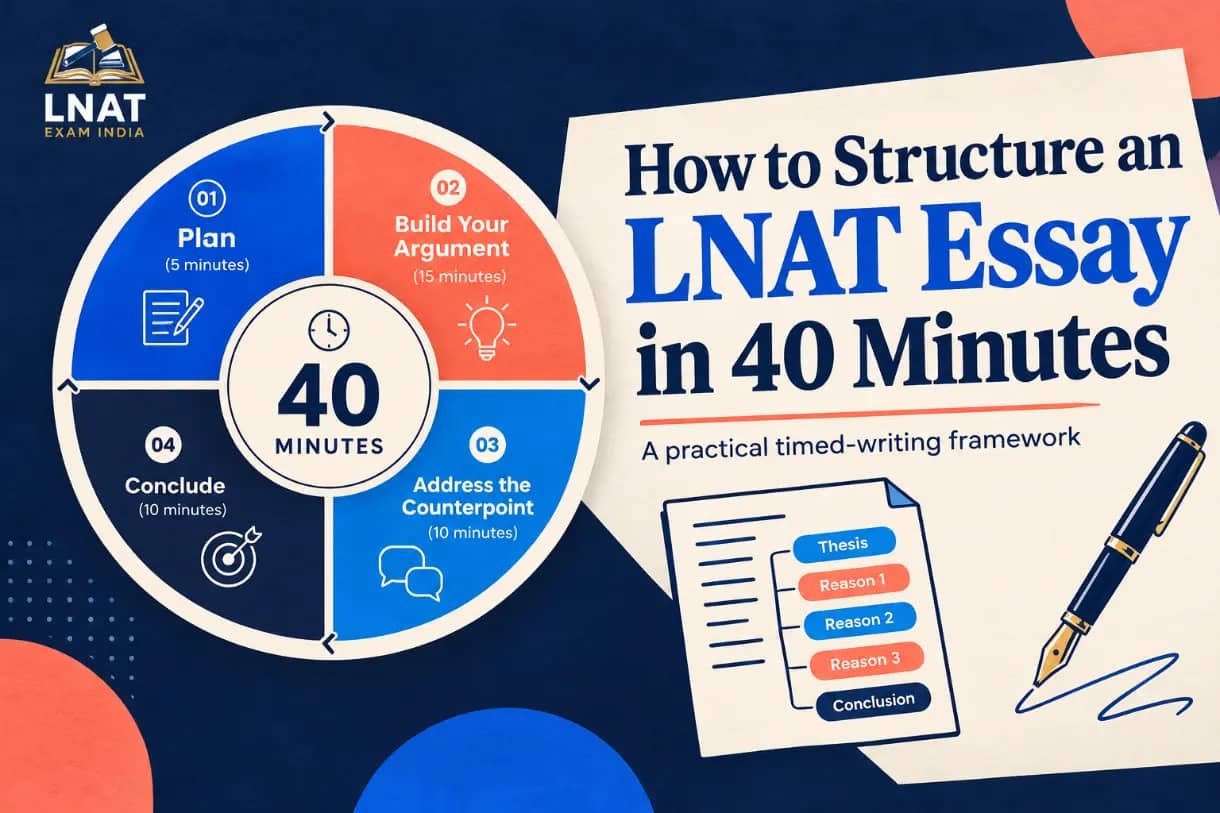
Good LNAT essay time management starts with dividing the 40 minutes into fixed blocks before you open the test. The plan below gives equal respect to thinking, writing and checking. Planning for five minutes may feel slow, but it saves far more time than it costs because you never stop mid paragraph to decide what to say next.
Stage | Minutes | Target Words | Purpose |
Choose the question | 0 to 5 | None | Read all three questions and commit to one |
Plan the essay | 5 to 10 | Short notes | Write the thesis, three points and one counterargument |
Introduction | 10 to 13 | 70 to 90 | State the issue, thesis and direction of argument |
Body paragraph one | 13 to 19 | 130 to 150 | Start from common ground and set the base |
Body paragraph two | 19 to 26 | 140 to 160 | Answer the strongest opposing view fairly |
Body paragraph three | 26 to 32 | 130 to 150 | Deliver your strongest and most persuasive reason |
Conclusion | 32 to 35 | 70 to 90 | Restate the thesis and give a firm judgement |
Proofread | 35 to 40 | None | Check logic, length, spelling and clarity |
The writing blocks add up to around 590 words, which sits comfortably inside the recommended range. If your typing speed is slower, trim each target by ten to fifteen words rather than skipping a paragraph.
Checkpoints That Keep You on Schedule
Treat the clock as a set of checkpoints rather than one long countdown. By minute five you should have chosen your question. By minute ten you should hold a written plan with a position and three points. By minute twenty you should be finishing your first body paragraph and moving into your second. By minute thirty five your conclusion should be written. Glance at the timer only at these moments so that you do not waste attention watching it.
Recovery Plan When You Run Behind
Every candidate falls behind at some point in practice, so prepare a rule in advance. If you reach minute twenty six and are still inside your second body paragraph, shorten the third paragraph to four or five focused sentences and protect your conclusion. A short conclusion that ties back to your thesis is always better than no conclusion at all. If you finish early, use spare minutes to strengthen your rebuttal rather than adding a new point.
Choosing the Right LNAT Essay Question in Five Minutes
Your first task is to read all three questions and commit to one quickly. Many applicants waste ten minutes switching between options. Set a firm limit of five minutes, then stay with your decision.
Choose the question where you can state a clear position in a single sentence and support it with three separate reasons. Familiar subject matter matters far less than argument potential, because the essay is judged on reasoning and structure rather than facts. Be careful with topics that make you very emotional, since strong feeling often leads to a one sided argument that ignores the other side.
Read the wording of the question slowly. Notice whether it asks if something is justified, whether it should be allowed, or whether you agree with a statement. Your thesis must answer that exact wording. An essay that argues well but answers a slightly different question will lose force with the reader.
LNAT Essay Planning Techniques That Work Under Pressure
Learning how to plan an LNAT essay is the single biggest upgrade you can make to your performance. A good plan is short, written in your own shorthand and detailed enough that you could write the essay from it without stopping to think. The following LNAT essay planning techniques fit inside the five minute planning block.
Thesis First Planning Method
Begin by writing one sentence that states your answer to the question. This sentence becomes the spine of the essay, and every later point must serve it. If you cannot write the thesis in a single sentence, your position is still unclear and you need another minute of thought before moving on.
Three Point Argument Map
Next, write three short points that lead the reader to your thesis. Many tutors recommend that point one rests on a common starting ground the reader will accept, point two deals with the strongest opposing view, and point three is your most persuasive reason. This order builds trust first, answers doubt in the middle and finishes with your strongest material when the reader is paying most attention.
Counterargument Check
Finally, write the best objection to your thesis in a few words and note how you will answer it. Addressing the other side without giving up your position shows maturity of reasoning. It also stops your essay sounding like a list of slogans.
LNAT Argumentative Essay Structure Paragraph by Paragraph
There is no single mandatory format, yet a clear LNAT essay structure of introduction, three body paragraphs and conclusion fits the time limit well and is easy for a reader to follow. Think of it as a short logical journey where each paragraph has one job.
Writing a Strong LNAT Essay Introduction
Spend about three minutes and 70 to 90 words on your opening. State the issue briefly, give your thesis clearly and signal the direction of your argument. For example, you might acknowledge a common view in one clause and then state your position in the next. Avoid empty openings that say there are many views on both sides of the debate, because they use words without saying anything.
Building Body Paragraphs That Argue and Rebut
Each body paragraph should follow the same pattern. Open with a topic sentence that states the point, explain the reasoning behind it, add one concrete example or analogy, and close by linking back to your thesis. Keep one idea per paragraph so the reader never loses the thread.
Your second paragraph carries extra work because it handles the opposing view. Present the strongest counterargument fairly, then explain why it fails or matters less than your position. Fairness matters here. Examiners can tell when an opposing view has been weakened on purpose to make it easy to defeat.
Closing With a Confident LNAT Essay Conclusion
Your conclusion needs about three minutes and 70 to 90 words. Restate the thesis in fresh wording, summarise how the three points support it and end on a firm final judgement. Do not introduce a brand new argument at this stage. A strong LNAT essay introduction and conclusion should mirror each other, so the reader finishes with the same clear answer they met at the start.
LNAT Essay Writing Strategy for the 25 Minute Writing Phase
Once the plan is ready, write steadily and trust it. Do not stop to reread each sentence. Your goal in this phase is a complete draft with a clear line of reasoning, not a perfect one.
Use plain, precise sentences. Short sentences carry logic better than long ones, and they are easier to correct during proofreading. Define any key term that your argument depends on, such as justice, harm or freedom, so that the reader knows exactly how you are using it. Use linking words such as therefore, however and as a result to make the logic visible.
Support claims with reasoning, everyday examples and sensible analogies instead of detailed facts. You do not need to remember statistics or legal cases. In fact, a long run of facts you cannot fully check can weaken an argument that should stand on logic alone.
Proofreading and Final Checks in the Last Five Minutes
Reserve the final five minutes for a calm review. Read your introduction and conclusion first and confirm that they give the same answer. Then scan each body paragraph for a clear topic sentence and a link back to the thesis. Correct spelling, punctuation and unclear phrasing last, because structural problems matter more than small typing slips.
Check your length as well. If you are close to 750 words, trim repeated points rather than cutting your conclusion. Stop editing when the time is almost over so that you are never caught halfway through a sentence.
Common LNAT Essay Mistakes That Waste Time
Several habits drain minutes without improving the essay. Starting to write before planning is the most common one, and it usually produces a draft that changes direction halfway. Choosing a question for its topic instead of its argument potential is another. Writing a long introduction, ignoring the opposing view and skipping the conclusion are also frequent problems.
A further mistake is trying to cover too many points. Four or five thin arguments read worse than three developed ones. In a 40 minute essay, depth beats breadth every time, and a balanced treatment of fewer ideas shows stronger analytical skill.
LNAT Essay Writing Tips for Daily Practice
Structure becomes automatic only through repetition. Begin your preparation two to three months before the test. In the early weeks, practise planning alone by taking a sample question and producing a thesis and three points in five minutes, without writing the essay. This builds speed cheaply.
Next, move to full timed essays under exam conditions, using the exact block times from the plan above. Aim for around two timed essays each week, and review each one by checking whether the thesis was clear, whether every paragraph linked back to it and whether the opposing view was answered fairly. Reading well argued opinion writing and discussing current issues with friends also strengthens your reasoning. If you are applying to Durham University, review its admissions requirements and practise your timed essays with the same plan.
Sample 40 Minute LNAT Essay Plan in Action
To see the method working, imagine a practice question asking whether the law should ever allow adults to refuse life saving medical treatment. This is a sample for training and not an official test question.
In the planning block, your thesis could be that competent adults should be free to refuse treatment because personal autonomy is a core value the law protects. Point one starts from common ground, which is that adults generally decide what happens to their own bodies. Point two meets the strongest opposing view, which is that the state has a duty to protect life, and explains why that duty cannot override a clear and informed choice. Point three is your strongest reason, which is that forcing treatment on a capable person damages the trust and dignity the medical system depends on.
Your introduction states the thesis and previews the three points. Each body paragraph then follows its job, and the conclusion restates the thesis with a final judgement. The whole essay fits inside the time table above because every decision about content was already made during planning.
How Our LNAT Preparation Course Builds Essay Structure Skills
Reading a method is useful, yet applying it under time pressure is a separate skill. Our LNAT preparation course turns the 40 minute plan in this guide into a training routine, with lessons on LNAT essay planning techniques, timed essay practice, model structures and clear feedback on your plans and drafts.
The course is designed to help you handle both sections of the test, so your essay timing improves alongside your Section A accuracy. You practise the same blocks, the same checkpoints and the same recovery rules until they feel natural on test day.
Conclusion
Learning how to structure an LNAT essay in 40 minutes comes down to a few dependable habits. Choose your question within five minutes, plan a thesis and three points in the next five, write an introduction, three body paragraphs and a conclusion in 25 minutes, and keep the final five minutes for proofreading. Use checkpoints to stay on time and a recovery rule for when you fall behind.
With regular timed practice, this structure stops feeling like a formula and starts feeling like a natural way to think. Your essay will read as clear, balanced and confident, which is exactly what admissions tutors hope to see. Applicants targeting the University of Bristol can use the same method to prepare with confidence.
