
On This Page
- 1.What an Assumption Means in LNAT Section A
- 2.How LNAT Assumptions Questions Appear in Multiple Choice Papers
- 3.Step by Step Method to Identify Assumptions in LNAT Passages
- 4.LNAT Critical Reasoning Techniques for Hidden Assumptions in Arguments
- 5.Assumption Versus Implication Versus Inference in LNAT
- 6.Common Wrong Answer Traps in LNAT Assumptions Questions
- 7.Worked Example of an LNAT Assumption Question
- 8.LNAT Passage Analysis Techniques for Faster Accuracy
- 9.LNAT Logical Reasoning Practice Questions and a Weekly Routine
- 10.Ways to Improve LNAT Reasoning Skills Over Time
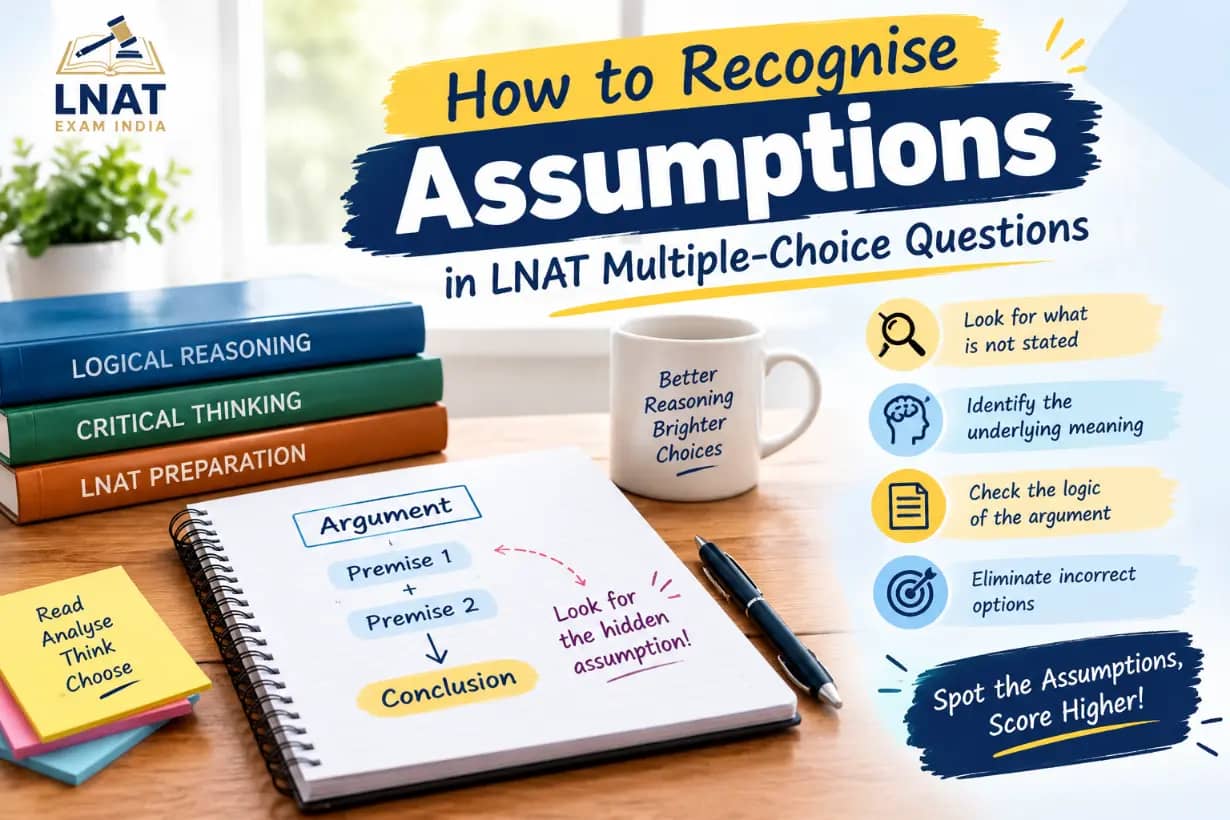
Learning how to recognise assumptions in LNAT multiple choice questions is one of the fastest ways to lift your Section A score. Assumption questions test whether you can see the invisible link between what an author states and what the author concludes. Most candidates lose marks here because they choose an answer that sounds sensible instead of one the argument genuinely needs. This guide gives you a repeatable method, a negation test, a worked example, the common traps and a practice routine, all built around the way the LNAT is actually written. Our LNAT course teaches the same method inside timed Section A drills, so you can move from understanding the idea to applying it automatically under pressure.
What an Assumption Means in LNAT Section A
An assumption is an unstated belief that an argument needs in order to move from its reasons to its conclusion. The author never says it out loud, yet if it were false the argument would fall apart. That single idea explains almost every LNAT assumptions question you will meet.
Every argument in a passage has three working parts. The conclusion is the point the author wants you to accept. The premises are the stated reasons offered in support. The assumption is the missing bridge between them. Consider a simple case. A writer says that a town has built a new library and therefore adult literacy there will rise. The premise is the new library. The conclusion is higher literacy. The assumption is that people who lack strong reading skills will actually use the library. Nothing in the text says so, but the conclusion depends on it.
Two points keep candidates safe. First, an LNAT assumption is not a claim you personally agree with or one that is true in real life. It only has to be something the argument relies on. Second, assumptions are always unstated. If the answer option simply repeats a sentence from the passage, it is a premise or a conclusion, not an assumption.
How LNAT Assumptions Questions Appear in Multiple Choice Papers
Section A of the LNAT contains 42 multiple choice questions based on 12 passages, to be completed in 95 minutes. That gives you roughly eight minutes per passage, and each passage usually carries three or four questions. The passages are drawn from serious journalism and academic style writing across law, politics, science, culture and society, so you never need prior subject knowledge. Everything you need is on the screen, which means the way to recognise assumptions in LNAT multiple choice questions is purely a matter of method. Leading law schools such as King's College London ask applicants to sit the test, so mastering Section A has a direct effect on your applications.
Assumption questions are phrased in several ways. You may see a stem asking which statement is an assumption made by the author. Another version asks what the argument depends on, or what must be true for the conclusion to hold. Some stems ask which of the following the writer takes for granted. All of these LNAT assumptions questions ask for the same thing, which is the unstated support the conclusion cannot do without. They sit alongside main point, inference, tone, strengthen and weaken questions, so being able to tell them apart quickly saves valuable time.
Step by Step Method to Identify Assumptions in LNAT Passages
The method below is the core of how to identify assumptions in LNAT passages. Practise it slowly at first, then let it speed up until it becomes a habit, because this is how you recognise assumptions in LNAT multiple choice questions under time pressure.
Mark the conclusion before reading the options
Read the relevant part of the passage and decide what the author is trying to prove. Look for signal words such as therefore, so, thus, hence, it follows that and clearly. A conclusion can also appear at the start of a paragraph and be supported by what follows. Write it in your own words in a few words. If you cannot state the conclusion simply, you are not ready to look at the options.
Separate the stated reasons from the claim
Next, list the reasons the author actually gives. Keep them short. This step stops you from choosing an option that merely repeats a reason, which is one of the most common errors in LNAT Section A multiple choice strategies.
Name the gap between reasons and conclusion
Ask what extra idea would have to be true for those reasons to lead to that conclusion. Often the gap is a jump from one type of thing to another, from correlation to cause, from a small group to a whole population, or from the past to the future. Say the gap to yourself in a sentence before you read the choices. This is the single most useful habit for identifying hidden assumptions in arguments.
Test each option with the negation test
For every option that looks promising, reverse its meaning and see what happens to the argument. If the negated option destroys the conclusion, the original option is necessary and is very likely the assumption. If the argument survives the reversal, the option is not required and you can reject it. The negation test works best for necessary assumptions, which is what the LNAT usually asks for, so it deserves a place in your toolkit from the first day of practice.
LNAT Critical Reasoning Techniques for Hidden Assumptions in Arguments
Strong LNAT critical reasoning techniques come from recognising the patterns that arguments use repeatedly. Once you know the patterns, hidden assumptions stop feeling hidden.
The causal leap is the most frequent pattern. The author observes that two things happen together and concludes that one causes the other. The hidden assumption is that no other factor explains the link and that the direction of cause runs the way the author claims. The representativeness leap appears when a survey, an example or a single case is used to describe a whole group. The assumption is that the sample is typical of everyone in the group.
The shift in terms pattern is subtler. A passage may begin by discussing popularity and end by drawing a conclusion about quality, or move from legal to moral, or from cheap to good value. The assumption is that the two ideas are close enough to treat as the same. The past to future pattern assumes that conditions that held before will hold again. The feasibility pattern assumes that because a policy is desirable it can actually be carried out. The all or nothing pattern assumes that only two options exist, so rejecting one forces acceptance of the other.
When you read, ask yourself which of these patterns the author is using. Naming the pattern narrows the field of possible assumptions in seconds and sharpens the quality of your LNAT passage analysis.
Assumption Versus Implication Versus Inference in LNAT
Many candidates confuse assumptions with implications and inferences, and the LNAT does test all three. An assumption sits behind the argument and supports it. An implication or inference comes after the argument and follows from it. A useful test is direction. If the statement is something the author needed before reaching the conclusion, it is an assumption. If it is something you can conclude after accepting the author's reasoning, it is an inference.
A presupposition is closely related to an assumption. It is something that must already be true for a statement to make sense at all. When an author writes about the failure of a scheme, the statement presupposes that the scheme existed. Treat presuppositions as assumptions in the narrow, logical sense. Keep your focus on what the stem asks, because choosing a correct inference on an assumptions question earns nothing.
Common Wrong Answer Traps in LNAT Assumptions Questions
Wrong options on LNAT assumptions questions are rarely random. They follow predictable designs, and learning them protects your score.
The first trap is the restated premise. The option sounds reasonable because it appeared in the passage, but it is stated, so it cannot be an assumption. The second trap is the extreme option, which uses words such as all, always, never or only. Assumptions are usually modest, and the strong wording goes beyond what the argument needs. The third trap is the true but irrelevant fact. It may be accurate and interesting, yet the conclusion does not depend on it, so the negation test exposes it at once.
Spotting these designs early is a core part of learning to recognise assumptions in LNAT multiple choice questions without second guessing yourself.
The fourth trap is the reversed relationship, in which cause and effect or condition and result are swapped. The fifth is the out of scope option, which introduces a new topic that the argument never touches. The sixth is the helpful but unnecessary option. It would strengthen the argument, but the argument can still stand without it. On assumptions questions the correct answer is required by the argument, not merely helpful to it.
Worked Example of an LNAT Assumption Question
Work through the following example using the four steps above. Read it first, then check the reasoning.
The passage says that cities which introduce free public transport see a clear rise in the number of people using buses and trains. The council of Marlow has therefore decided to make all of its buses free, and it argues that this will reduce traffic congestion in the town centre.
The question asks which of the following is an assumption on which the council's argument depends.
Option A says free buses will cost the council less than road repairs. Option B says many of the new bus passengers will be people who previously drove cars into the town centre. Option C says other towns have also made their buses free. Option D says traffic congestion is the most serious problem facing Marlow. Option E says bus drivers will support the policy.
Start with the conclusion. The council believes free buses will reduce congestion. The stated reason is that free transport increases the number of passengers. The gap is clear. More passengers do not reduce congestion unless some of them leave their cars at home. That points to Option B. Apply the negation test. If none of the new passengers were drivers, then congestion would not fall, and the conclusion fails. Option B is necessary.
The other options fall into the traps described earlier. Option A introduces cost, which is out of scope. Option C is true or false without affecting the logic. Option D exaggerates, and the council does not need congestion to be the worst problem. Option E is a helpful condition but not required for the claim to hold.
LNAT Passage Analysis Techniques for Faster Accuracy
Good LNAT passage analysis techniques make assumption questions easier because they train you to see structure rather than detail. Read the passage once for the main line of argument. Notice how each paragraph contributes, whether it gives a reason, a counter argument, an example or a concession. Pay attention to signpost words such as however, although, because and consequently, since they reveal where reasoning turns.
Keep brief notes on any rough paper the test centre provides, limited to the conclusion and one or two key reasons. Resist the urge to highlight every sentence. Spend about eight minutes per passage, and if an assumption question resists you after a minute, mark it, choose the best option and move on. There is no negative marking in Section A, so every question deserves an answer.
LNAT Logical Reasoning Practice Questions and a Weekly Routine
LNAT logical reasoning practice questions are most useful when they mirror the real test. Begin with the official practice material available on the LNAT website at lnat.ac.uk, then add passages from quality newspaper editorials and opinion columns. For each editorial, state the conclusion, list the reasons and write down the assumption in one sentence. This builds the habit even when no multiple choice options are provided. Also read the admissions guidance of your target law school, for example Durham University, to see how the test score is used in selection.
A simple weekly routine works well for most candidates. On two days, complete one timed passage with its questions and review every answer, including the ones you got right. On two more days, analyse one editorial without options, naming the argument pattern it uses. On one day, revisit an error log in which you record each missed assumption question, the trap you fell for and the correct reasoning. Once a week, take a full timed Section A set to build stamina. Inside our LNAT course, guided assumption drills, timed Section A sets and detailed answer explanations follow this same cycle, so your practice always has feedback attached. That feedback loop is what turns practice into a reliable ability to recognise assumptions in LNAT multiple choice questions.
Ways to Improve LNAT Reasoning Skills Over Time
If you want to improve LNAT reasoning skills in a lasting way, treat your preparation as a training programme rather than a revision sprint. Read serious writing every day, from long form journalism to legal and policy commentary, and always ask what the author takes for granted. Debate ideas with a friend and challenge each other to name the hidden assumption behind a claim. Review your error log weekly and look for patterns, since most candidates repeat the same two or three mistakes.
Accuracy comes before speed. Build correct reasoning first, then tighten your timing until the four step method takes under a minute per question, which is the real goal when you recognise assumptions in LNAT multiple choice questions on test day. Over several weeks you will notice that assumptions stand out almost immediately, and your confidence in the whole of Section A will grow with it. This steady progress matters whether you are aiming for University of Bristol or any other selective law school.
