
On This Page
- 1.Quick Summary of the Difference Between LNAT Section A and Section B
- 2.LNAT Exam Format Explained for International Applicants
- 3.LNAT Section A Multiple Choice Questions in Detail
- 4.LNAT Essay Section Explained
- 5.Key Differences Between LNAT Section A and Section B in Skills, Scoring and Strategy
- 6.How Universities and JGLS Use Each Section
- 7.How to Prepare for LNAT Section A and Section B Effectively
- 8.Common Mistakes Applicants Make in Each Section
- 9.How LNAT Exam Coaching Supports Both Sections
- 10.Conclusion: Treat LNAT Section A and Section B as One Connected Skill Set
Every year, students planning to study law in the United Kingdom, or at Jindal Global Law School, ask the same thing about the Law National Aptitude Test: what is the difference between LNAT Section A and Section B? The short answer is that Section A is a scored multiple choice test of 42 questions in 95 minutes, while Section B is a 40 minute essay that LNAT does not score but universities read. Understanding that difference changes how you plan your time, your practice and your university strategy. This guide explains the LNAT exam format, the LNAT Section A time limit, how LNAT essay assessment works, and how to prepare for both parts together.
Quick Summary of the Difference Between LNAT Section A and Section B
The LNAT is a computer based admissions test that lasts 2 hours and 15 minutes in total. It does not test legal knowledge. It measures how well you read, reason and argue, which is why the same preparation now serves applicants to UK law schools and to Jindal Global Law School. The test has two parts that run in a fixed order, and each part has its own time limit that cannot be shared with the other.
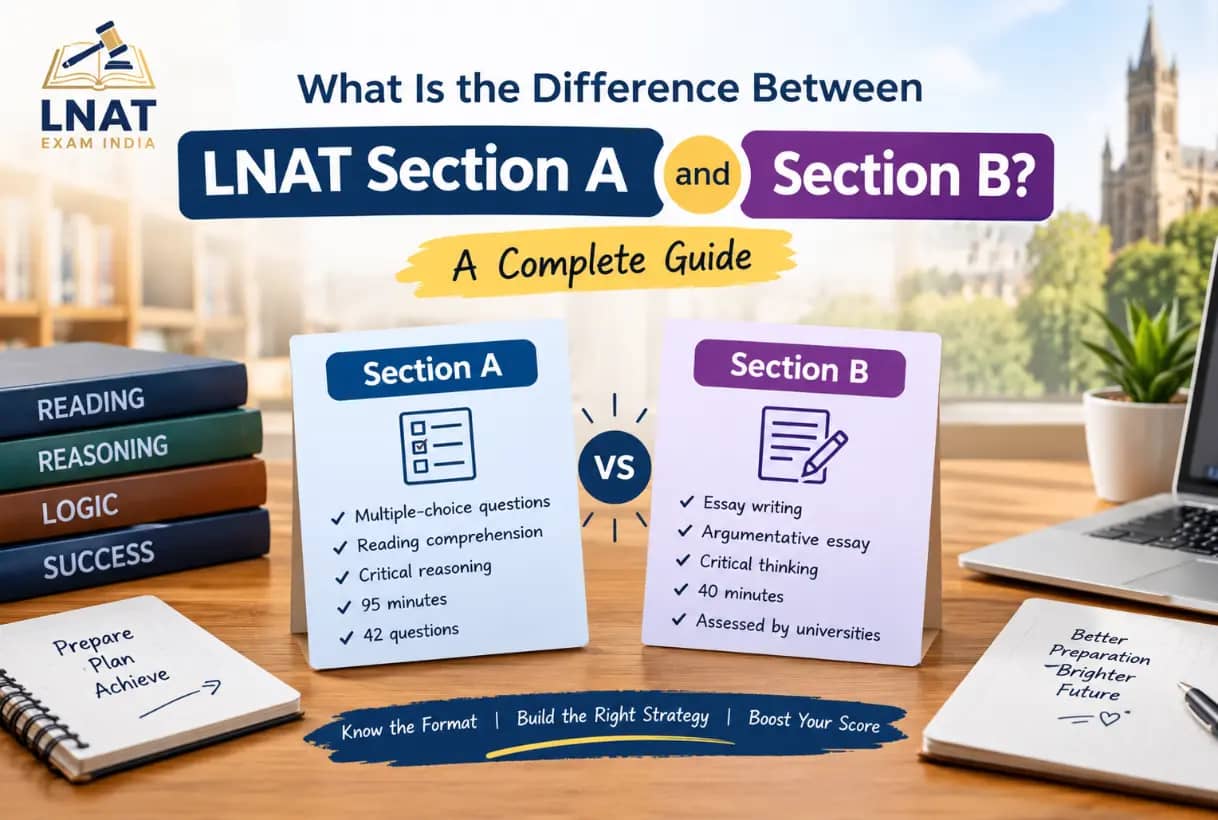
Section A is the multiple choice part. You read 12 argumentative passages and answer 42 questions in 95 minutes, with three or four questions attached to each passage. Section B is the essay part. You choose one of three prompts and write a single argumentative essay in 40 minutes. The table below places the two sections side by side so you can see the difference between LNAT Section A and Section B at a glance.
Feature | LNAT Section A | LNAT Section B |
Format | Multiple choice questions on passages | One argumentative essay |
Tasks | 42 questions on 12 passages | One essay chosen from 3 prompts |
Time limit | 95 minutes | 40 minutes |
Order | Taken first, review allowed during the section | Taken second, no return to Section A |
Main skill | Reading comprehension and logical reasoning | Argument, structure and written English |
Scoring | Marked by computer, score out of 42 | Not scored by LNAT, sent to universities |
Negative marking | None | Not applicable |
Recommended length | Not applicable | 500 to 600 words, maximum 750 |
JGLS use | Yes, only this section is used | No |
The most important practical point in the table is this. Section A produces your LNAT score, while Section B produces a piece of writing that goes to your chosen universities without a numerical mark from the test provider.
LNAT Exam Format Explained for International Applicants
The LNAT exam format is the same for every candidate in the world. The test is administered by Pearson VUE, and applicants in major cities sit it at a Pearson VUE test centre in cities such as Delhi, Mumbai, Bengaluru, Chennai, Hyderabad and Pune. The registration fee for centres outside the United Kingdom and the European Union is about 120 pounds, which comes to roughly 13,000 rupees, so confirm the current fee on the official LNAT website at lnat.ac.uk before you book.
You may attempt the LNAT once in each admissions cycle, so the format is worth learning properly before test day. You answer all 42 multiple choice questions first. While Section A is open you can review and change your answers freely, but once you move on to Section B you cannot return to Section A. After that, the 40 minute essay clock begins.
LNAT Section A Multiple Choice Questions in Detail
Section A is where your numerical score comes from, and for several universities it is the only part that counts. These LNAT multiple choice questions reward careful reading and disciplined time use far more than background knowledge.
LNAT Section A Time Limit and Pacing
The LNAT Section A time limit is 95 minutes for 42 questions, which works out to roughly two and a quarter minutes per question. A practical plan is to give each of the 12 passages about seven minutes, including the questions attached to it. That uses 84 minutes and leaves about 11 minutes to revisit difficult items. Because time cannot move between sections, any minute you save in Section A is only useful inside Section A. Treat the review window as part of your plan rather than a bonus.
LNAT Reading Comprehension and Question Types
Every passage is an argument or an opinion on a general topic such as technology, society, ethics or public policy. LNAT reading comprehension is not speed reading. The questions ask you to identify the main conclusion, separate evidence from opinion, judge whether an inference follows, and interpret how a word or phrase is used in context. Each question offers several answer options and only one is correct, and the wrong options are often tempting because they are partly true. A frequent mistake is choosing the answer you personally agree with instead of the answer the passage actually supports.
How LNAT Section A Is Scored
Each correct answer earns one mark and there is no negative marking, so you should never leave a question blank. A computer marks Section A and reports a score out of 42, which is what universities mean when they refer to your LNAT score. Scores vary from year to year, but published guidance from tutoring providers generally places the national average in the low twenties out of 42, which is why every extra correct answer matters. Universities that require the LNAT, such as King's College London, receive this score directly as part of your application.
LNAT Essay Section Explained
The LNAT essay section tests something quite different from Section A. Instead of choosing from given answers, you build your own argument from a blank screen, without spell check, grammar check or outside help. It shows universities how you think and write under pressure.
LNAT Section B Time Limit, Word Count and Question Choice
You have 40 minutes to write one essay, chosen from three prompts on subjects such as law and society, ethics, politics or current affairs. Official guidance recommends around 500 to 600 words, with a recommended maximum of 750 words, so longer is not better. A sound use of the 40 minutes is about five minutes choosing a question and planning, about 30 minutes writing, and about five minutes checking that your argument and conclusion are clear.
LNAT Essay Assessment by Universities
LNAT essay assessment is the part that confuses applicants most. The test provider does not give the essay a numerical mark. Your essay is sent to every participating university you apply to, alongside your Section A score, and each university reads it using its own criteria. Some institutions give the essay real weight. Others consult it only in borderline cases or not at all. Bristol has been reported to blend an essay band into its formula, while the London School of Economics is reported to rely on Section A alone. Policies change between cycles, so always check the admissions page of each university you are targeting.
Key Differences Between LNAT Section A and Section B in Skills, Scoring and Strategy
The deepest difference between LNAT Section A and Section B is the kind of thinking each one demands. Section A is a receiving task. You are given an argument written by someone else and must analyse it accurately, quickly and without letting your own opinions interfere. Section B is a producing task. You must create an argument of your own, organise it clearly and finish it with a conclusion before the clock runs out.
Scoring is the second major difference. Section A is objective. A computer counts your correct answers and nothing else matters. Section B is judged by human readers at universities, who look for a clear position, logical structure, thoughtful engagement with the opposing view and accurate written English.
Strategy is the third. In Section A, accuracy comes from elimination, careful reading of qualifying words such as all, some, never and usually, and steady pacing. In Section B, quality comes from planning before writing, answering the exact question asked, and resisting the urge to include every idea you know. A candidate who is excellent at one and neglects the other leaves marks or impressions on the table.
How Universities and JGLS Use Each Section
Universities use the two sections differently, and this should shape how you divide your preparation time. Some UK law schools treat the Section A score as a shortlisting filter and read the essay only for candidates who pass that filter. Others read every essay carefully. For Jindal Global Law School, which has adopted the LNAT as the entrance test for its LLB programmes, only the Section A score is used according to current LNAT Exam guidance.
If your only target is Jindal Global Law School, most of your energy belongs in Section A. If you are applying to UK universities, you need both sections to be strong, because a weak essay can undermine a good Section A score at institutions that read it closely. Durham, for example, says on its Durham University page that it considers both parts of the LNAT, including the essay,. Read each university page before you decide how to split your preparation time. When you are unsure, prepare for both. The skills overlap more than most applicants expect, since careful reading improves writing and clear writing sharpens your sense of how arguments are built.
How to Prepare for LNAT Section A and Section B Effectively
Section A Preparation Plan
Begin with an untimed practice passage so you understand the question styles, then move to timed sets of three passages in about 21 minutes. Read serious editorials and opinion writing every day and summarise the main conclusion of each in one sentence. After every practice set, sort your mistakes into types, such as misreading a qualifier, over interpreting a claim, or running out of time. Official practice material is available on the LNAT website, and you should use it before moving to extra mock papers.
Section B Preparation Plan
Practise writing plans before you practise writing full essays. A good plan states your position in one sentence, lists two or three supporting points, names the strongest objection and explains why your position still stands. Then write timed essays of 500 to 600 words and ask a mentor to review them. Check whether you answered the exact question, whether each paragraph has one clear job, and whether your conclusion follows from what you argued.
A Weekly Routine That Covers Both Sections
A balanced week might include three timed Section A sets, two essay plans, one complete timed essay and one review session where you study errors and rewrite weak paragraphs. In the final month before your test date, sit a full length mock under exam conditions, with 95 minutes for Section A followed straight away by 40 minutes for Section B. This builds the stamina that the real two hour fifteen minute test demands.
Common Mistakes Applicants Make in Each Section
In Section A, the most common mistakes are spending too long on one difficult question, bringing in outside knowledge that the passage does not support, and leaving questions unanswered despite there being no negative marking. In Section B, the most common mistakes are starting to write without a plan, refusing to take a position, ignoring the opposing view, writing far beyond the recommended length and running out of time before a conclusion. Each of these is fixable with timed practice and honest feedback.
A useful habit is to keep a short error log for both sections. After each practice session, write down what went wrong and what you will do differently next time. Over a few weeks the log shows patterns, such as repeated misreading of qualifiers in Section A or weak conclusions in Section B, and those patterns tell you exactly where to focus.
How LNAT Exam Coaching Supports Both Sections
LNAT Exam is built around the LNAT and nothing else. It is not a general law entrance course with an LNAT chapter added on. The programme begins with a diagnostic that measures your starting level in reading, reasoning and essay writing and sets a target against your chosen universities. It then moves through structured skill building for Section A question types and Section B essay technique, full length timed mocks with detailed feedback, individual essay coaching, and application support covering registration, deadlines and university strategy.
Learning is delivered through live classes, small batches and one to one sessions, with lead mentor Mr Alastair Murray, who brings an experienced background in language examining and writing assessment. The coaching is designed for applicants from CBSE, ISC and IB schools, so it accounts for those backgrounds, the Jindal Global Law School route, local test centres, rupee fees and the UCAS steps that applicants often get wrong. If you want help deciding how to split your time between Section A and Section B, a free consultation is the best place to start.
Conclusion: Treat LNAT Section A and Section B as One Connected Skill Set
The difference between LNAT Section A and Section B comes down to format, time, scoring and skill. Section A is a 95 minute, 42 question multiple choice test scored by computer out of 42. Section B is a 40 minute essay that LNAT does not score and that universities read for themselves. Yet the two sections draw on the same ability to understand an argument, weigh it fairly and respond with clear reasoning. Candidates who prepare them together, with realistic timing and regular feedback, enter the test centre with real confidence.
Ready to build a plan that fits your target universities and your deadline? Book a free LNAT consultation with LNAT Exam at lnatexamindia.com, or message a mentor on WhatsApp, and get a personalised preparation plan for both Section A and Section B.
Sources consulted: the official LNAT website at lnat.ac.uk, including its test format and what is the LNAT pages, and published guidance from UniAdmissions, Leading Tuition, All About Law, The Profs and Exams Ninja. University policies and fees change, so verify current details on lnat.ac.uk and each university website.
